

Koh Rong Lands At Number Nine: The Coastal Investment Signal Worth Reading

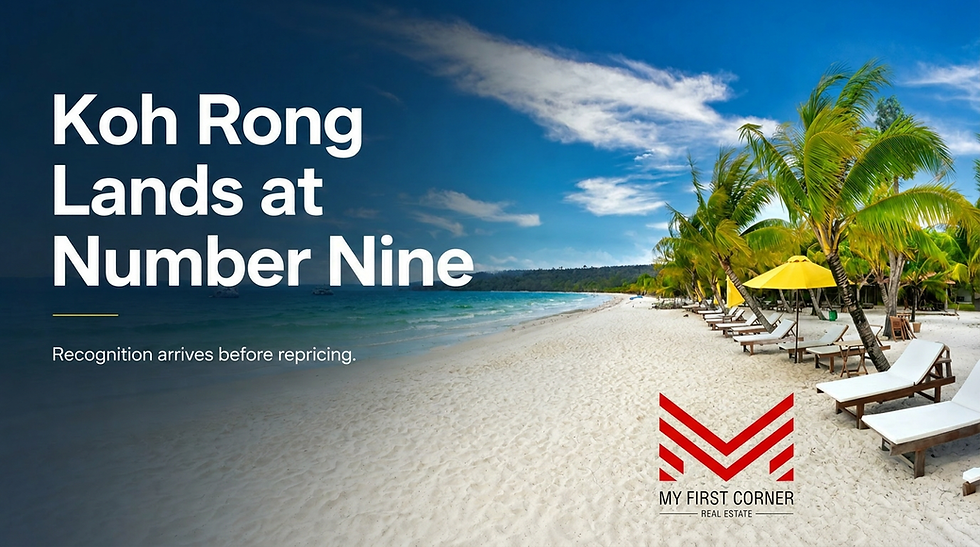
Koh Rong has been ranked the ninth-best beach in the world on the 2026 World's 50 Best Beaches list, a ranking voted on by more than 1,000 travel professionals. The Cambodian island sits ahead of celebrated destinations including Grace Bay in Turks and Caicos, Seven Mile Beach in the Cayman Islands, Anse Source d'Argent in the Seychelles, and Le Morne in Mauritius. For anyone considering a Koh Rong investment, or who already holds exposure to Cambodia's coastline, this is not a curiosity. It is a data point.
The ranking and what it tells you
Lists like these are sometimes dismissed as travel marketing. This one is not built that way. The methodology is a professional vote, not a public popularity poll, and the panel is drawn from journalists and influencers who specialize in destination travel. The signal is the consensus, not any single judgment.
What that consensus produces is interesting on its own terms. The top ten includes three Southeast Asian beaches: the Philippines at number one, Cambodia at number nine, and Thailand at number ten. The region accounts for almost a third of the global top ten in a list that is geographically diverse and covers every habitable continent. That is the headline.
The sub-headline is that Cambodia, a market many international investors still file under "frontier tourism," is now sitting in the same neighborhood as the Maldives. A reader who only follows asset prices would not have predicted that pairing.
The pricing gap between perception and recognition
There is a useful pattern in coastal real estate that repeats across decades and across regions. Recognition arrives first. Visitor numbers follow. Hospitality investment follows visitor numbers. Residential and mixed-use pricing follows hospitality. The gap between the first step and the last can run anywhere from three to ten years, and it is during that gap that early capital tends to find the cleanest entry points.
This is not a Cambodia-specific observation. It described Tulum a decade ago. It described Hoi An before the heritage tourism wave. It described El Nido before international rankings began noticing it. In each case, an early ranking, an early travel feature, or an early word-of-mouth wave preceded a repricing cycle that the casual market participant only noticed once it was largely complete.
Koh Rong has now received the recognition. What happens between this ranking and the eventual repricing is the period investors should be studying.
What the ranking does not change
A measured reading of this kind of signal also requires honesty about what has not changed. Koh Rong is still reached by ferry from the mainland. Power and water infrastructure on the island remains less developed than what investors find in mature resort markets. Land tenure for foreign investors in Cambodia follows specific structures, and any serious coastal acquisition involves legal architecture that the buyer needs to understand before signing anything.
These are not weaknesses. They are conditions. The price an investor pays today reflects them. The price an investor pays in three or five years will reflect a different set of conditions, and the question is whether the work to close that gap is already in motion.
The supply side gives a partial answer. Hospitality operators have continued to expand their footprint across the Koh Rong archipelago. Larger condo and villa projects in the wider Sihanoukville coastal corridor have continued to advance through the pipeline. Capital is committing in a measured way, which is generally a more durable signal than a sudden rush.
What gets repriced first
In coastal repricing cycles, the order of price movement is not random. Beachfront land moves first, because supply is fixed and easy to recognize. Adjacent land within walking distance of a marquee beach moves second. Inland land within roughly a fifteen-minute drive moves third. Operator-led hospitality assets, hotels and serviced residences, often move on a different timeline because their pricing is anchored to revenue rather than scarcity.
For a coastal investor evaluating Koh Rong and the surrounding archipelago, the question is not just whether to buy, but where in the supply chain to position. The cleanest entries are usually the ones that capture more than one of these layers at once. A site with beachfront exposure, walking access to commerce, and a pathway to hospitality income tends to compound across all three repricing layers, not just one of them.
Time horizon and the Koh Rong investment thesis
Early capital in coastal repricing cycles tends to do best on a five-to-ten-year horizon, not a one-to-two-year one. The reason is mechanical. Hospitality infrastructure takes time to design, permit, build, and stabilize. Airport upgrades take longer. Ferry routes take longer still. The investor who buys the day after a beach ranking and tries to exit in eighteen months is usually disappointed. The investor who buys with a seven-year hold, and a clear thesis about which infrastructure milestones close the gap, tends to get paid.
This is the part of the analysis that does not make for exciting reading. It is also the part that separates the investors who compound from the investors who chase.
The point of a list like this one is not the ranking itself. It is what the ranking compresses into a single sentence: that a panel of more than 1,000 destination experts looked at every coastline on earth and placed a Cambodian island in the top ten. That sentence will be read by hotel groups, by tour operators, by airline route planners, by yacht charter companies, and by family offices with appetites for second-home portfolios. Some of those readers will move slowly. Some will move quickly. The aggregate of their decisions is what eventually reprices a coastline.
The opportunity in Koh Rong is not the ranking. It is the time between the ranking and the repricing.
Investors who study coastal markets before the consensus arrives tend to spend less time deciding when the consensus does arrive. The work done at this stage rarely looks urgent, but it is usually the work that pays the most.
At My First Corner, this is the kind of analysis we run before a client signs anything on a coastal asset. The conversation is available when it is useful.


Comments