

Cambodia's Hidden Gem Beyond Angkor Wat
- Jack Camden

- Mar 18
- 3 min read

When people think of Cambodia, Angkor Wat almost always defines the conversation. And rightly so—it is one of the world’s most extraordinary cultural landmarks. But Cambodia’s real depth begins to unfold once you move beyond its most iconic silhouette.
Step outside Angkor, and the country reveals itself differently. What you find is not a secondary list of destinations, but a layered and diverse landscape: slow-moving river towns, understated coastal provinces, forested highlands, island escapes, and a capital city that reflects a rapidly evolving modern identity.
For travelers seeking a more complete understanding of Cambodia, these places offer something essential—perspective.

Battambang and the beauty of restraint
If Siem Reap is Cambodia’s global stage, Battambang feels like its quiet counterpoint.
There is a softness to the city. Tree-lined streets, aging colonial buildings, independent cafés, and a subtle creative energy shape an environment that does not demand attention, but earns it slowly. Battambang is best experienced without urgency—wandering rather than planning.
Beyond the city center, the countryside unfolds quickly into rice fields, small villages, and narrow roads that remain deeply connected to agricultural life. At dusk, Phnom Sampeau offers one of Cambodia’s most surreal sights: thousands of bats streaming from a cave in a continuous ribbon across the sky.
Battambang does not try to compete with Angkor. Instead, it offers something rarer—a sense of space and stillness.
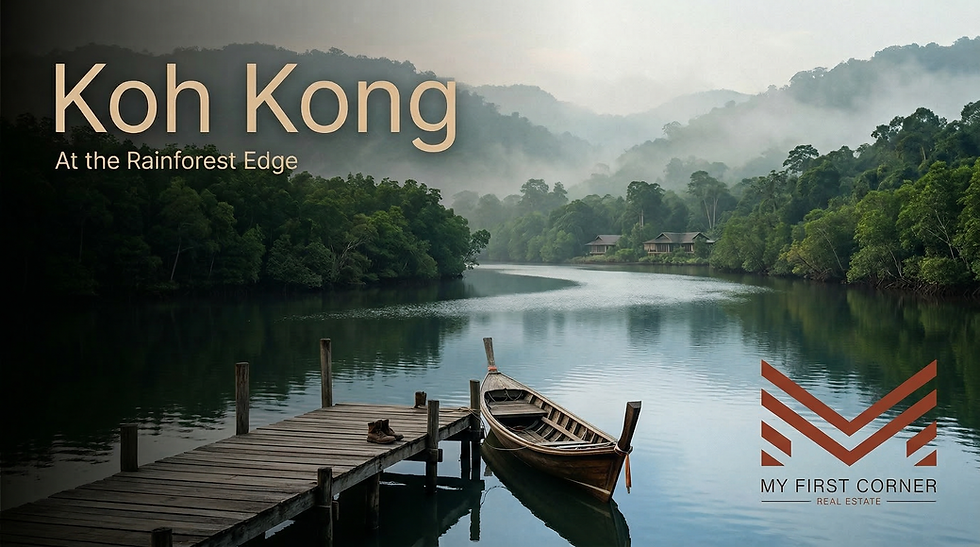
Koh Kong and the rainforest edge
For those who associate Cambodia mainly with temples, Koh Kong feels like a shift in geography—and mindset.
Located near the Thai border, the province opens into the vast Cardamom Mountains, one of Southeast Asia’s last great rainforest regions. Here, the landscape becomes more fluid: rivers replace roads, and dense forest replaces urban structure.
Experiences in Koh Kong lean toward immersion rather than spectacle. Boat rides along the Tatai River, eco-lodges built over water, and mangrove systems like Peam Krasop Wildlife Sanctuary create a slower, more observant style of travel.
Koh Kong is a reminder that Cambodia is not only historical—it is deeply ecological.

Kep and the value of understatement
Unlike many Southeast Asian beach destinations, Kep does not try to impress loudly.
Its charm lies in restraint. Quiet mornings, fresh seafood, and a slower coastal rhythm define the experience. The coastline may not be dramatic, but its simplicity feels intentional rather than lacking.
Remnants of old seaside villas hint at a different era of Cambodian leisure, while Kep National Park offers shaded trails and gentle views over the sea. The town’s well-known crab market continues to anchor its identity.
Kep works precisely because it does not try too hard. In travel, that often signals authenticity.

Kampot and the slow river effect
If any place in Cambodia seems designed to soften time, it is Kampot.
Set along a calm river with the Elephant Mountains in the distance, Kampot is defined more by atmosphere than attractions. Days unfold naturally—riverside cafés, countryside drives, visits to pepper farms, and long, unstructured afternoons.
This balance is what draws such a diverse crowd, from short-term travelers to long-stay visitors and remote workers. Kampot offers comfort without overdevelopment, and energy without pressure.
It is often the place people intend to visit briefly, only to extend without much thought.

Koh Rong Samloem and the disappearing-noise effect
Cambodia’s islands are no longer entirely hidden, but Koh Rong Samloem still holds onto something increasingly rare—quiet.
The island offers clear water, soft sand, and a noticeably reduced pace of life. Saracen Bay provides easy access, while more secluded areas like Lazy Beach feel almost detached from the modern world.
The appeal here is not luxury in the conventional sense. It is simplicity—fewer distractions, fewer decisions, and a sense of calm that feels increasingly valuable.
Why these places matter
To experience only Angkor is to see a single, remarkable chapter of Cambodia. To go further is to understand its full narrative.
There is the reflective Cambodia of Battambang.The ecological Cambodia of Koh Kong.The coastal ease of Kep and Kampot.The quiet islands of Koh Rong Samloem.The raw landscapes of Ratanakiri.And the evolving urban story of Phnom Penh.
Together, they create a more complete map—one that explains why Cambodia resonates long after the journey ends.
Bottom Line
Angkor Wat will always be central to Cambodia’s identity. But the country becomes far more compelling once you move beyond it.
That is where its quieter strengths emerge—places defined not by scale, but by atmosphere, rhythm, and experience.
And more often than not, those are the places people remember most.


Comments