

What Passive Income Real Estate Actually Costs You

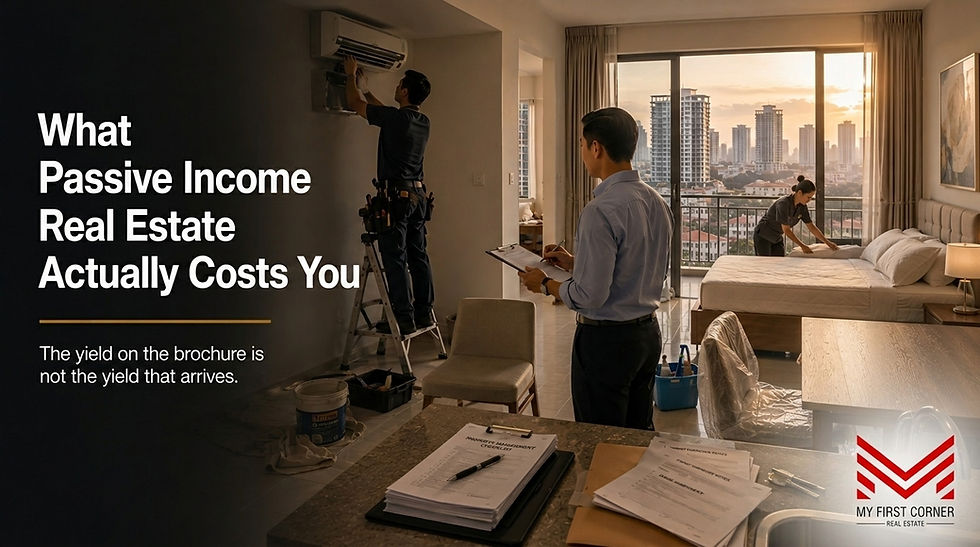
A Phnom Penh condominium marketed at a 7 percent gross yield rarely deposits 7 percent into the owner's account. Subtract the management fee, the monthly maintenance charge, the weeks the unit sits empty between tenants, and the furniture that wears out faster than the building, and the figure that survives is often closer to four. The arithmetic of passive income real estate in Cambodia tells a quieter story than the brochure, and it is worth reading slowly.
Passive income has become shorthand for money that arrives without effort. The phrase is accurate about location and misleading about cost. The effort does not vanish when an investor buys a rental unit. It changes form, moving off the owner's calendar and onto a series of recurring invoices. What looks like the absence of work is usually work that has been converted into a line item.
The costs that arrive before the rent does
Before a single dollar of rent appears, the unit has already consumed capital beyond the purchase price. A one-bedroom condominium furnished to a standard tenants will actually pay for tends to absorb several thousand dollars in furniture, appliances, and fit-out. Title transfer and registration carry their own fees. Then comes the quietest cost of all, the interval between handover and the first signed lease, during which the unit produces nothing while still accruing maintenance charges. An owner who models income from day one has already mispriced the asset.
The management line nobody prices in
Professional management in Phnom Penh typically costs between 8 and 12 percent of collected rent, and that figure buys tenant sourcing, rent collection, and the coordination of repairs. The alternative, self-management, is not free. It is simply a cost paid in the owner's hours rather than the manager's fee, and it scales badly the moment the owner lives in another country. Vacancy compounds the problem. A unit empty for one month out of twelve has already surrendered more than 8 percent of its annual income before any fee is deducted. Two tenant turnovers in a year, each with its cleaning and re-listing gap, can quietly remove a month of rent without ever appearing in the original yield calculation.
What passive income real estate really asks of an owner
The building depreciates, but so does the income. Common-area maintenance and sinking-fund charges in Phnom Penh condominiums are usually levied per square meter each month, and across a year they represent a fixed claim on rent regardless of whether the unit is occupied. Inside the unit, the furniture that made it rentable has a working life measured in a few years, not decades. Air-conditioning, appliances, and soft furnishings reach the end of their useful life on a schedule, and replacing them is the cost of keeping the rent at the level the spreadsheet assumed. Passive income real estate, examined honestly, is a system that has to be maintained to keep producing, not a switch that stays on by itself.
The cost that does not show up as a number
There is a final cost that resists tabulation. Every rental asset generates decisions, about tenants, repairs, renewals, and the occasional dispute, and decisions require attention even when they are delegated. The owner who treats a rental unit as a small business tends to keep more of the yield than the owner who treats it as a lottery ticket that pays monthly. The distinction is not effort for its own sake. It is the difference between income that is managed and income that is merely hoped for.
Passive income is a description of where the work sits, not proof that the work is gone. An investor who prices the full cost stack before buying tends to choose better assets and argue less with the results later. The work done at this stage looks unglamorous, and it is usually the work that protects the return. At My First Corner, modeling the real net yield, after fees, vacancy, and the cost of staying rented, is part of the analysis we run before a client commits to an asset. The conversation is available when it is useful.


Comments